This is a brief guide to using the Poor Law Union and Workhouse [PLU] collection.
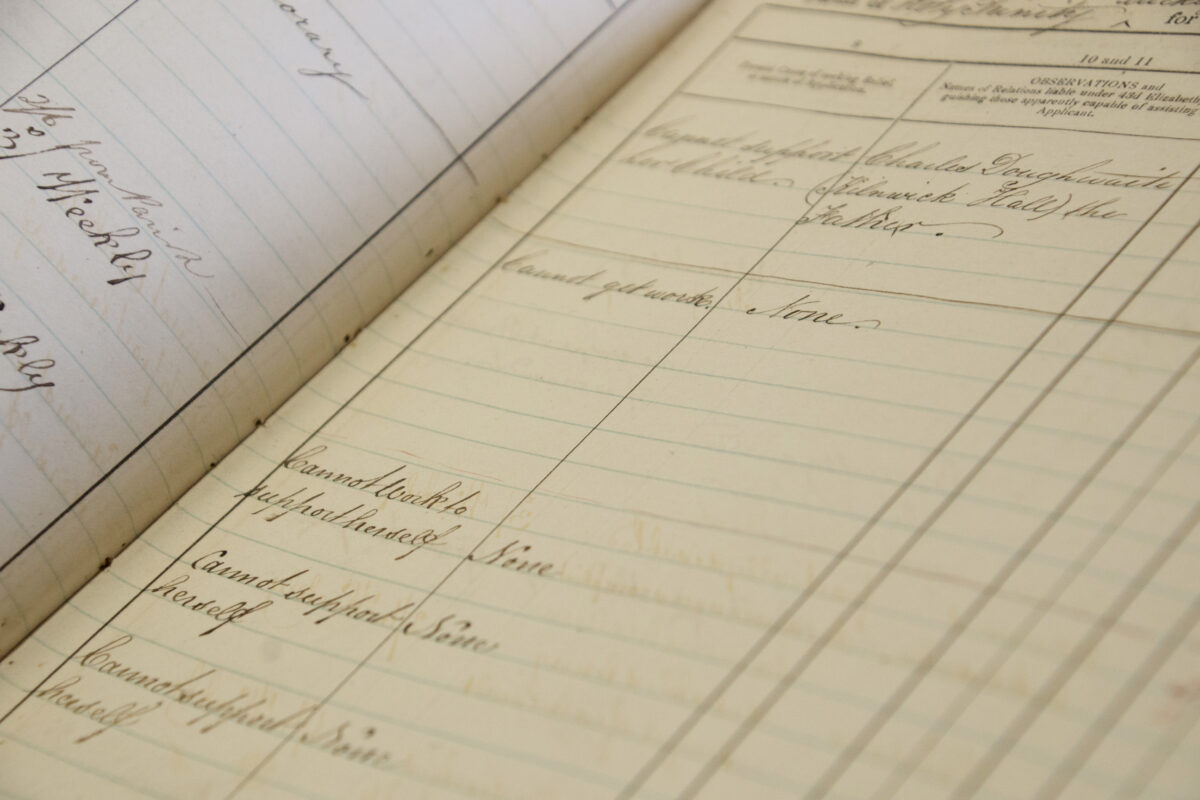
The collection includes records relating to governance of the Union; indoor relief (workhouse relief); outdoor relief; the collection of relief; settlement and removal; child welfare; hospitals and asylums; public health; assessment and rating; civil registration; the general administration of the Union (including staffing); financial records; legal case paper and summonses; and records relating to properties and buildings owned or tenanted by the Union. It also includes records of the York Public Assistance Committee, which was responsible for the administration of the Poor Law from 1930-1948.
Many of the records relating to indoor relief and outdoor relief contain information on individuals and are useful for researching family history; the social and economic history of York as well as the wider history of welfare provision. Please note that many of the records in the collection are subject to Data Protection provisions.
Additional finding aids and contextual documentation for this collection are available in the Reading Room.
Rural parishes
The rural parishes within York registration districts fell within the East, North and West Ridings of Yorkshire, and therefore the poor law records for these areas may be held at other archive services. Details of the websites for the other archive services are given in the ‘York-related resources held in other repositories’ section of this guide.
East Riding
Records from rural parishes in the following Poor Law registration districts may be held at the East Riding Archives:
Walmgate: Gate Fulford, St Lawrence Heslington, St.Paul’s Heslington, and Water Fulford.
Dunnington: Elvington, Grimston, Kexby, Langwith; and Scoreby and Stamford Bridge.
Escrick: Deighton, Escrick, Naburn, Stillingfleet with Moreby, Thorganby with West Cottingwith and Wheldrake.
North Riding
Records from rural parishes in the following Poor Law registration districts may be held at the North Yorkshire Archives:
Walmgate: Heworth and Osbaldwick.
Bootham: St Olave’s Marygate.
Marygate: Clifton, Earswick, Huntington and Towthorpe.
Dunnington: Gate Helmsley, Holtby, Murton, Upper Helmsley, Warthill (Freehold and Copyhold) and Stockton on the Forest.
Flaxton: Buttercrambe, Claxton, Flaxton upon the Moor, Harton, Lillings Ambo, Sand Hutton and Strensall.
Skelton: Beningborough, Haxby, Overton, Rawcliffe, Skelton and Wigginton.
West Riding
Records from rural parishes in the following Poor Law registration district may be held at the West Yorkshire Archive Service:
Micklegate: Acaster Malbis, Angram, Askham Richard, Bishopthorpe, Copmanthorpe, Dringhouses, Holgate (may have been considered part of York City for Poor Law purposes), Middlethorpe and Upper Poppleton.
- PLU/1 – Governance Comprises minutes of committee meetings of the York Poor Law Union (including the York Out-Relief Union, the Bishopthorpe Out-Relief Union, the Flaxton Out-Relief Union and the Escrick Out-Relief Union); and from 1930 the Public Assistance Committee. Also includes the minutes of the Nuisance Removal Committee and the York Rural Sanitary Authority; and minutes of organisations administered by the York Poor Law Union including the York Charities Register Committee and Hodgson’s Charity Committee.
- PLU/2 – Indoor (workhouse) relief Comprises records relating to the admission, discharge and maintenance of inmates of the York Workhouse, which was later known at the City Institution and then The Grange). Also includes records relating to the staffing and administration of the Workhouse.
- PLU/3 – Outdoor relief Comprises records relating to the administration of relief granted to the poor in their own home (i.e. outside the Workhouse, hence the term ‘outdoor relief’). Includes application and report books, weekly outdoor relief lists, relief order books, relief granted on loan, relieving officers’ receipt and expenditure books, relief in kind books and records relating to medical relief.
- PLU/4 – Collection (repayment) of relief Comprises records relating to the collection of relief from liable individuals. The York Poor Law Union (and later the Public Assistance Committee) attempted to recover money spent on relief that had been granted to the poor. They ordered individuals – usually liable relatives – to contribute towards the cost of maintaining those in receipt of poor relief. The collection of relief was administered by the Collecting Committee. Includes order books, notices to contribute, payment ledgers, receipt and payment books, registers of insurance benefits and adjourned cases, claim made to the Ministry of Health, and Collectors’ accounts and correspondence. See also PLU/13/1 for legal cases relating to recovery of relief.
- PLU/5 – Settlement and removal records Comprises registers of non-settled and non-resident poor; also registers of removal orders and settlement enquiries.
- PLU/6 – Children Comprises records concerning the welfare of children who came into the care of the York Poor Law Union and later the Public Assistance Committee. Includes records relating to apprenticeships; registers of children boarded out and in farm service; register for enforcing school attendance; and correspondence concerning the boarding out of children.
- PLU/7 – Hospitals and asylums Comprises records relating to the maintenance of pauper patients in hospitals and asylums. Includes records relating to the City Fever Hospital at Yearsley Bridge; the York City Mental Hospital at Naburn; and Grove House, a private asylum at Acomb.
- PLU/8 – Public health Comprises records relating to the preventative public health measures administered by the York Poor Law Union. Includes vaccination registers; register of tuberculosis notifications; and correspondence of the York Rural Sanitary Authority.
- PLU/9 – Assessment and rating Comprises records relating to the administration of the poor rate. The poor rate was a local tax on the yearly value of a property, levied by the parish. The money collected from poor rates was used to help finance relief for the poor as well as the infrastructure of administering that relief. From 1837 to 1925 the York Poor Law Union was responsible for administering the poor rate, and, occasionally, other rates such as the lighting rate.
- PLU/10 – Registration Records relating to the civil registration of births, deaths and marriages. Poor law unions were used as registration districts from 1837, when civil registration was introduced. Comprises the outgoing letterbooks of the Superintendent Registrar; and correspondence between the Superintendent Registrar of York and the Registrar General, London.
- PLU/11 – Administration Comprises records relating to the general administration of the York Poor Law Union and Public Assistance Committee. Includes correspondence; statistics and returns; staffing records; government orders; and publications and other printed material.
- PLU/12 – Finance and accounts Comprises financial records relating to the general administration of the York Poor Law Union and Public Assistance Committee. Includes financial statements; general ledgers; parochial ledgers; treasurers’ ledgers; treasurers’ receipt and payment books; invoices; petty cash books; receipts; and other account books. (For financial records relating specifically to outdoor relief see PLU/3/5; for financial records relating specifically to the collection of relief see PLU/5/10)
- PLU/13 – Legal Comprises records relating to legal cases pursued by, or involving the York Poor Law Union. Includes legal case papers, summonses, warrants, orders and inquests.
- PLU/14 – Properties and buildings Comprises records relating to property and buildings owned or tenanted by the York Poor Law Union. Includes records concerning the sale and purchase of properties; the erection, development and maintenance of buildings; and the financing of building projects.
Our archive collections can be searched and browsed on the archive catalogue: https://archives.exploreyork.org.uk/index.php/
You can find more information on how to search the archive catalogue on the ‘How to Search’ webpage: https://archives.exploreyork.org.uk/how-to-search
To book an appointment to access our archive collections and find details of our opening times and how to book an appointment, please refer to our ‘Visiting us’ webpage: https://exploreyork.org.uk/archives/visiting-us/
- Fowler, Simon. Using Poor Law Records, Richmond : Public Record Office, 2001 [Shelf mark: 929.341(FH)]
- King, Steven et al, In Their Own Write: Contesting The New PoorLaw 1834-1900, London: McGill-Queen’s University Press: 2022 [Shelf mark: 362.585]
- Raymond, Stuart A. Tracing Your Poor Ancestors : A Guide for Family Historians, Barnsley: Pen & Sword, 2020 [Shelf mark: 929.1 PEO]
- Poor Law archives Flickr album: https://www.flickr.com/photos/127532267@N05/albums/72157714286315421
- Poor Law Union timeline Flickr album: https://www.flickr.com/photos/127532267@N05/albums/72177720325647158/with/54482441255
- East Riding Archives holds archives relevant to areas within the current City of York boundaries which were historically within the East Riding of Yorkshire: https://www.eastridingarchives.co.uk/
- North Yorkshire Archives holds archives relevant to areas within the current City of York boundaries which were historically within the North Riding of Yorkshire: https://www.northyorks.gov.uk/leisure-tourism-and-culture/north-yorkshire-archives
- West Yorkshire Archive Service holds archives relevant to areas within the current City of York boundaries which were historically within the West Riding of Yorkshire: https://www.wyjs.org.uk/archive-service/
- The National Archives’ ‘How to look for records of… Poverty and the Poor Laws’ guide: https://www.nationalarchives.gov.uk/help-with-your-research/research-guides/poverty-poor-laws/